
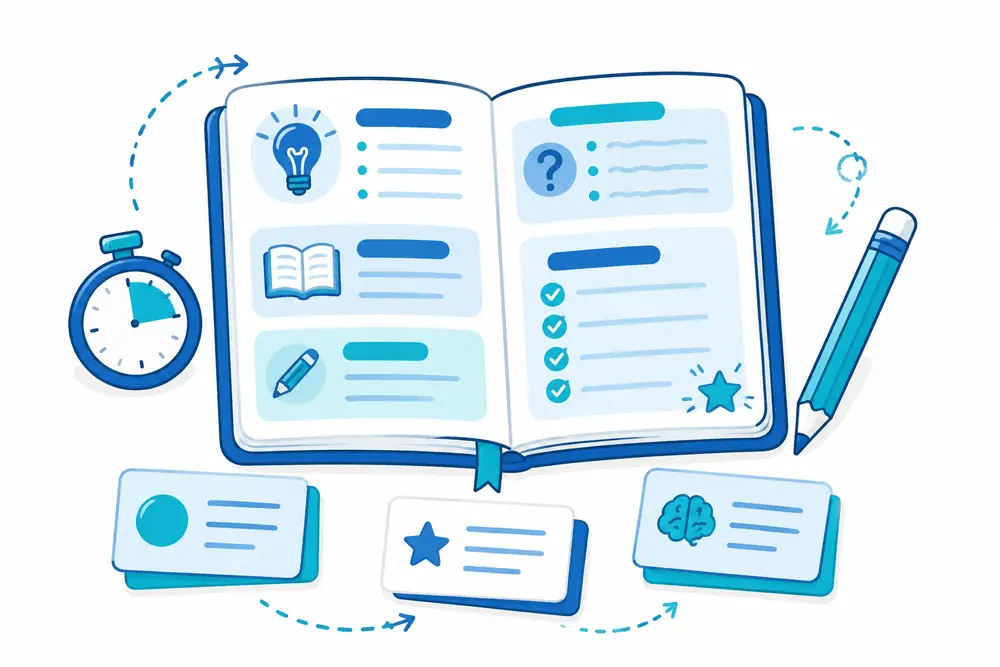
A study guide is a focused learning tool. It turns class material into a clear review plan. Most guides collect key ideas, terms, examples, and questions in one place.
A useful guide does more than shorten your notes. It helps you find gaps, recall facts, and practise using ideas. Think of it as a map. Your textbook is the whole city, while the guide shows the roads you need.
What is a study guide?
A study guide is an organized summary made for learning and review. It can be a page, notebook, book, card set, chart, or digital file. Students often use one before a quiz, exam, or final project.
The best guides connect facts with actions. They ask you to define, compare, solve, label, explain, or recall. That active work matters because reading alone can feel familiar without proving knowledge.
In plain terms, a study guide answers three questions. What must I learn? How will I practise it? How will I know I am ready?
Did you know?
A study guide can reveal weak topics before an exam. That makes it a diagnostic tool, not only a summary.
Why do study guides work?
A guide reduces a large course into smaller learning targets. This lowers the mental load. You can see what deserves attention instead of jumping between chapters.
Good guides also support active recall. You cover an answer, try to remember it, then check your result. This simple loop gives honest feedback. As the saying goes, the proof is in the pudding.
Spacing adds another benefit. You review the guide across several days instead of one long night. Cornell University recommends distributed practice and repeated retrieval for stronger learning. See its effective study strategies.
Study guide versus class notes
Class notes record what happened during a lesson. A study guide reorganizes that material around learning goals. Notes may follow the teacher’s order. A guide follows the learner’s needs.
You do not need to replace your notes. Use them as source material. Then pull the important ideas into a shorter, test-ready format.
Study guide versus a textbook
A textbook teaches a full subject with detail and context. A study guide selects the material needed for a goal. It may point back to textbook pages when more detail is needed.
A guide should never become a tiny textbook. If every detail survives, the guide has not made a useful choice.
Common types of study guides
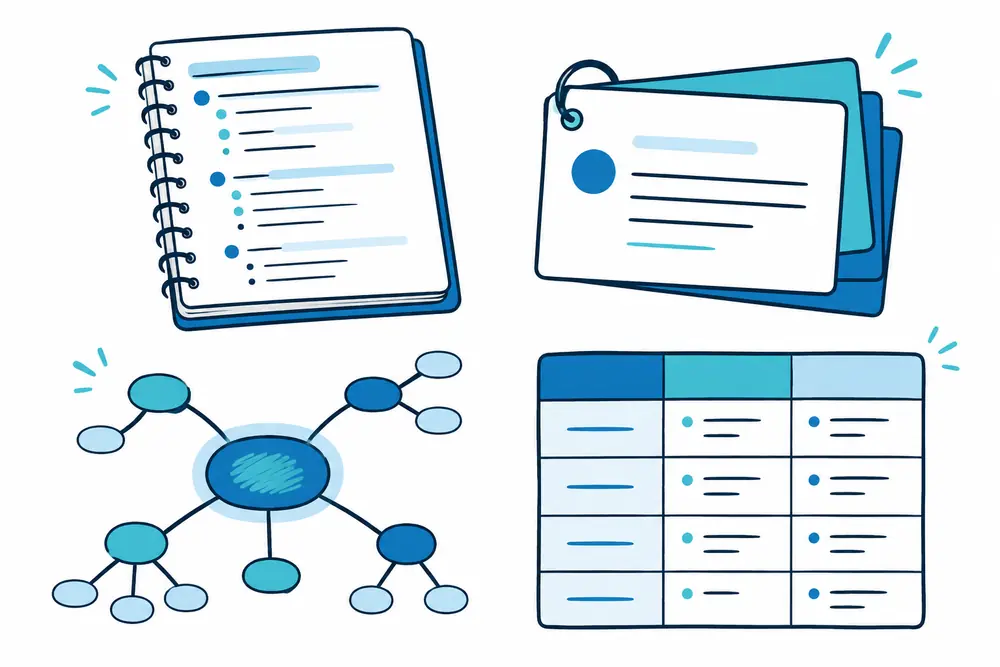
The right format depends on the subject and task. There is no magic layout. Horses for courses, as people say. Pick the structure that matches the thinking your exam requires.
Outline guides
An outline groups topics under clear headings. It works well for history, literature, law, and social science. Add short explanations instead of copying full paragraphs.
Question-and-answer guides
This format turns facts into prompts. Put the question on one side and the answer elsewhere. It suits vocabulary, dates, formulas, and short concepts.
Concept maps
A concept map shows relationships between ideas. Use arrows and short labels. It helps with biology systems, causes and effects, and connected theories.

Comparison charts
A chart places similar ideas side by side. It makes differences easier to spot. Use it for scientific processes, historical events, grammar rules, or competing theories.
Practice-based guides
Some subjects need doing, not describing. Math, coding, accounting, and physics guides should include worked examples. They also need fresh problems without visible answers.
What should a study guide include?
A basic guide needs clear learning goals, key concepts, useful examples, and practice questions. Add definitions where exact language matters. Include diagrams when location or sequence matters.
An answer key is important, but keep it separate. Easy access can turn practice into copying. Also mark the source for facts, formulas, and quotations.
Our detailed good study guide checklist explains each part. It also shows how to test a guide before relying on it.

How do you create a study guide?
Start with the course goal, not a blank design. Review the syllabus, lesson goals, assignments, and teacher comments. These sources reveal what has been stressed.
Next, sort material into a few main topics. Write one short explanation for each. Then add a question that forces you to use the idea. A question should be more than a copied heading.
Use a format that fits the subject. A timeline helps with events. A labeled drawing helps with anatomy. A problem set helps with equations. One size does not fit all.
Finally, test the guide without notes. Put a mark beside missed questions. Those marks become the next review plan. The Utah State University Academic Success Center also explains how creating study guides can organize course material.
How should you use a study guide?
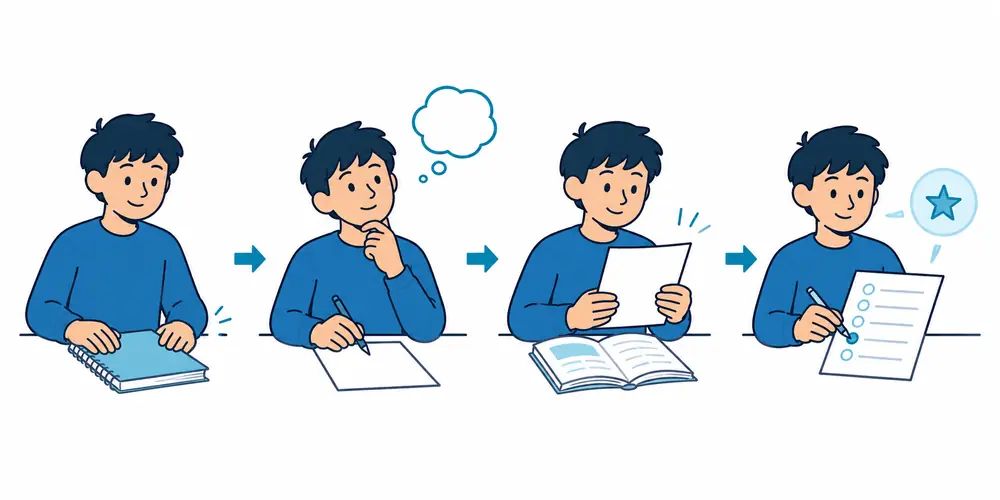
Read the learning goal first. Close the guide and explain the idea aloud. Then answer a question or solve a problem. Check your response only after making a real attempt.
Sort each topic into three groups. Use ready, unsure, and not ready. Spend most time on the last two groups. Do not polish the material you already know.
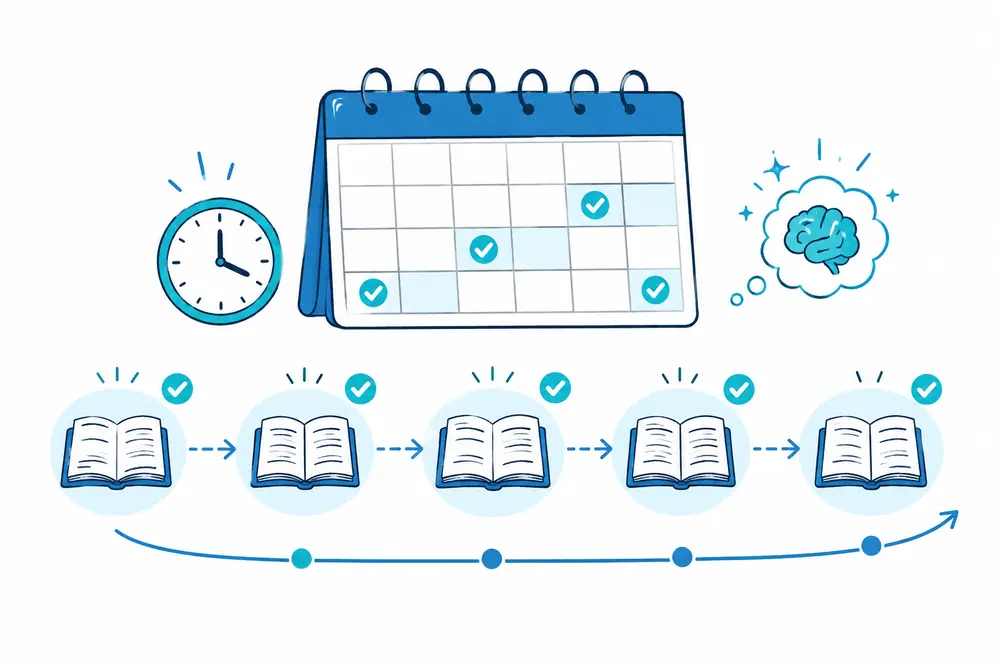
Review again after a gap. A simple plan uses short sessions across several days. Each session should begin with recall, not rereading. Slow and steady wins the race.
If you prefer a printed resource, read what a study guide book is. You can also compare formats in our guide to choosing the best study guide.
Common study guide mistakes
The first mistake is copying everything. Copying feels productive because the page fills quickly. Yet it does not require you to choose, connect, or retrieve ideas.
The second mistake is making the guide too pretty. Color can show structure. Decoration can hide weak content. Build the questions first, then improve the layout.
Another mistake is using only definitions. Many exams ask students to apply, compare, or explain. Match your practice to those actions.
Last, avoid checking answers too soon. Productive struggle helps expose the exact gap. Give yourself a fair attempt before opening the key.
Read next
See practical study guide examples for common subjects.
How to choose reliable study guide sources
Begin with the official course materials. Use the syllabus, teacher notes, assigned textbook, and current exam outline. These sources define the target. A random website may explain a topic well, but it may cover another level.
Check names, dates, formulas, and definitions against two reliable sources. This step matters when a course changes often. Technology, health, law, and certification content can become outdated quickly.
Look for a named author, clear editor, and recent update date. A trustworthy guide explains where its facts came from. It also separates firm facts from helpful advice.
When sources disagree, follow the source used by your course or exam provider. Make a short note about the difference. Better safe than sorry.
How study guides change by subject
A math guide should center on problems. Include formulas, worked examples, and fresh questions. Show common errors, but keep final answers away from the practice page.
A science guide needs processes, causes, diagrams, and evidence. Label parts from memory. Explain what changes when one part of a system changes.
A history guide should connect dates with causes and results. Use timelines for order. Add questions that require evidence, comparison, and a clear claim.
A language guide needs words inside sentences. Include grammar patterns, reading, listening, and writing when the course tests them. The map must match the journey.
How to build practice from easy to hard
Start with short recall questions. Ask for a term, fact, formula, or step. These questions confirm the basic material before you tackle a larger task.
Next, ask for an explanation or comparison. Use words such as why, how, and what changes. These prompts reveal whether ideas connect inside your mind.
Then add application. Use a new example, unfamiliar problem, or short case. Application prevents a guide from becoming a memory list.
Finish with mixed practice. Mix topics and question types. This forces you to choose the right idea without a heading giving away the method.

A simple seven-day study guide plan
On day one, list the goals and take a short diagnostic test. Mark topics as ready, unsure, or not ready. Do not study before this first check.
On days two and three, build the main guide. Work on weak high-value topics first. Add explanations, examples, and recall questions as you go.
On days four and five, practise without notes. Record errors and correct the reason behind each one. Review the error list at the next session.
On day six, complete mixed practice. On day seven, run a short final review and rest. Do not cram new material at the eleventh hour.
How to use AI with a study guide
AI can turn your verified notes into questions, tables, or practice prompts. Give it the exact learning goal and required level. Ask it to keep answers separate.
Never assume an AI answer is correct. Check facts against course sources. Watch for made-up references, wrong formulas, and confident claims without evidence.
Use AI to create a fresh example after you understand the rule. Solve the example first. Then ask for feedback and compare that feedback with a trusted source.
Keep private information out of prompts. Do not share student records, account details, or private class files. A useful tool still needs sensible boundaries.
How to use a guide in group study
Give each person a topic to explain without notes. Other members should ask one follow-up question. This method exposes gaps without turning the meeting into silent reading.
Compare answers against the course source. Do not accept the loudest voice as the final authority. Many hands make light work, but accuracy still needs a check.
Trade practice questions and solve them alone. Then discuss different methods. A good group session creates more attempts, not more copying.
End with a shared list of weak topics. Each learner should keep a personal plan. The group can support progress, but it cannot do the remembering for you.

Make a study guide easier to use
Use clear headings, readable text, and strong color contrast. Do not use color as the only label. Add words, symbols, or patterns so meaning stays clear.
Write short sections and leave useful space. A crowded page makes priorities harder to see. Digital guides should work on a phone without tiny text.
Add descriptive text for important images. Explain diagrams in nearby words. Captions help every reader understand why a visual belongs.
Choose formats that fit your access needs. Audio notes, printed pages, large text, and keyboard-friendly files can all support the same learning goal.
Turn class notes into a study guide
Read one lesson at a time. Circle the main goal, key ideas, and examples. Move only those useful parts into the guide.
Rewrite ideas without looking at the original sentence. Then compare your version with the notes. Correct missing meaning before moving on.
Turn headings into questions. Change “Photosynthesis” into “How does photosynthesis store energy?” A question creates a reason to retrieve the idea.
Add teacher feedback beside the matching topic. Past mistakes often predict the best next question. Make hay while the sun shines.
How often should you update a study guide?
Update it after each lesson or assignment when possible. Ten minutes now can prevent an hour of sorting later.
Remove corrected errors after several successful reviews. Keep a short record if the mistake often returns. The guide should reflect current needs.
Add new questions when practice becomes too familiar. Repeated answers may test memory of the page instead of the idea.
Check the full guide one week before the exam. Confirm every goal has practice and every practice item has feedback.

Measure progress with evidence
Count correct answers without notes. Record the topic and question type, not only the total score. A total can hide one weak area.
Track how well you explain the reason. Correct answers with weak reasons need another review. Understanding should survive a follow-up question.
Compare results across spaced sessions. Improvement after a gap matters more than improvement during one sitting.
Use the results to change the next plan. What gets measured gets managed, but keep the tracking simple.
Use the guide before and during exam week
During the final week, focus on questions and errors. Avoid rewriting the whole guide. The building stage should already be finished.
Complete mixed practice under realistic conditions. Review weak reasoning after the session. Save easy topics for short confidence checks.
The night before, use a brief checklist and stop at a sensible time. Sleep supports attention and recall. Burning the midnight oil can backfire.
Follow the exam rules about allowed materials. If a guide is permitted, organize it for quick finding. If not, use it only during preparation.
Signs your study guide is working
You can explain topics without reading the page. You can answer new questions and correct mistakes with a clear reason.
Weak topics change after each review. The guide becomes shorter and sharper instead of growing forever. Progress feels earned, not guessed.
You also know what to study next. A useful guide removes uncertainty from the plan. That clear next step is half the battle.
Your practice becomes more accurate after a gap. You need fewer hints, and you can handle questions with unfamiliar wording.
The guide also saves time. You stop hunting through every source because goals, questions, and corrections stay connected.

Study guide FAQ
Is a study guide the same as an answer sheet?
No. An answer sheet gives results. A study guide teaches, organizes, and checks learning. It may include an answer key, but practice comes first.
Can a study guide be one page?
Yes. A one-page guide can work for a small quiz or focused topic. The page still needs clear priorities and useful recall prompts.
Should I make or buy a study guide?
Making one improves understanding because you select and organize ideas. Buying one can save time and add practice. Many students combine both approaches.
Can AI create a study guide?
AI can help create questions, summaries, and formats. You must check every fact against course material. Your teacher’s goals should guide the final version.
The final takeaway
A study guide is a plan for active review. It highlights what matters and gives you ways to practise. The format can change, but the purpose stays steady.
Start small. Choose one topic, write five recall questions, and test yourself tomorrow. Why wait for exam week to discover what you missed?