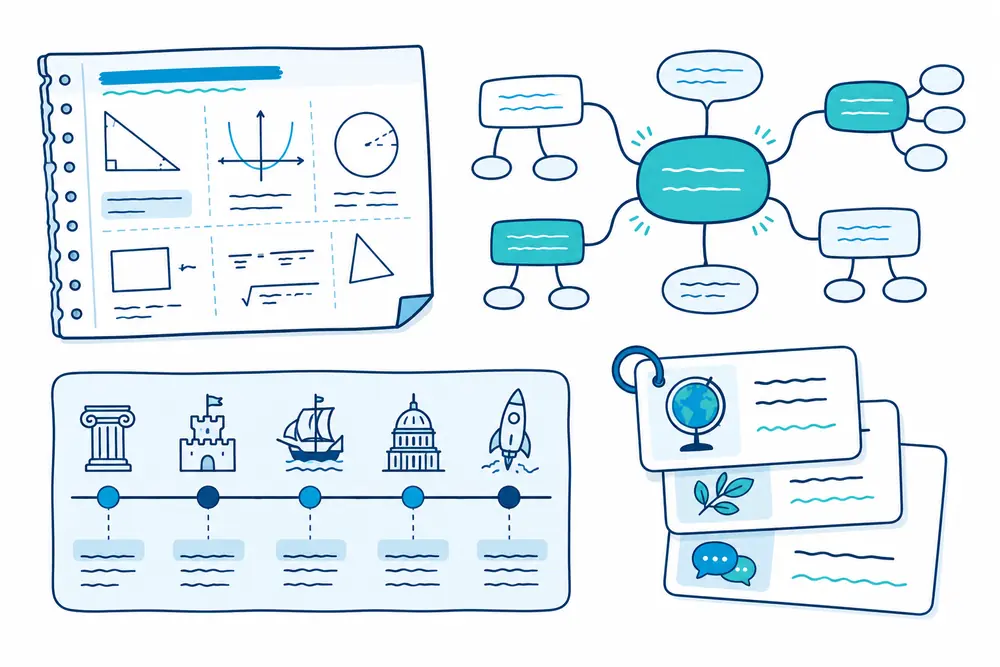
The best study guide examples match the subject. A math guide uses problems and formulas. A biology guide uses diagrams and processes. History needs timelines and evidence. Language study needs words in context.

Below are practical layouts you can copy and change. Each example includes a goal, content, recall prompt, and review method.
What are some examples of study guides?
Common examples include outlines, flashcards, concept maps, comparison charts, timelines, formula sheets, and practice tests. A strong guide often combines several formats.
The format should match the action. Use a chart to compare. Use a timeline for order. Use questions for recall. Use worked examples for problem solving.
Did you know?
One topic may need two formats. A process map can teach order, while questions test recall.
A basic study guide template
Start each guide with the topic and learning goal. Add a short explanation, one example, and several questions. Keep answers in another section.
Finish with a confidence check and next review date. This final step turns a page into a plan. A stitch in time saves nine.

Math study guide example
Topic: solving linear equations. Goal: solve one-step and two-step equations, then check each answer. Start with the rule for keeping both sides equal.
Key rule: perform the same operation on both sides. Worked example: solve 2x + 3 = 11. Subtract three, then divide by two. Check by replacing x with four.
Practice prompts should remove the worked steps. Include positive numbers, negative numbers, fractions, and one word problem. Place solutions after the full set.
Add an error box. Record sign errors, skipped operations, and weak checks. This box is more useful than copying another perfect example.
Math guide layout
Use a formula or rule section, two worked examples, and a mixed problem set. Leave blank space for calculations. Mark the questions that need another attempt.

Biology study guide example
Topic: cellular respiration. Goal: explain the purpose, main stages, and basic inputs and outputs. Begin with a one-sentence overview.
Add a flow diagram for glycolysis, the Krebs cycle, and the electron transport chain. Label the cell location for each stage. Keep details at the required course level.
Practice questions can ask for order, location, purpose, and comparison. Include one question about what changes when oxygen is limited.
Cover the diagram labels and rebuild the process. That test shows more than rereading. The proof is in the pudding.

History study guide example
Topic: causes of the American Revolution. Goal: compare political, economic, and social causes. Use a three-column chart for category, evidence, and effect.
Add a short timeline with the Stamp Act, Boston Tea Party, and Intolerable Acts. Do not treat the timeline as the full explanation. Connect each event to a larger cause.
Practice prompts should ask why, how, and which evidence matters most. Include one short thesis question. Then list two facts that could support the claim.
History guides improve when they separate fact from argument. Dates are anchors. Explanations are the bridge between them.
Language study guide example
Topic: travel vocabulary and past tense. Goal: understand common words and describe a completed trip. Group words by situation, not alphabet.
Write each word inside a useful sentence. Add a small grammar pattern with two correct examples. Then create a short prompt about a past journey.
Practice should include recall in both directions. Hear or read the target language and explain it. Then create the target sentence from an idea.
Avoid trusting translation alone. Context shows meaning, tone, and grammar. Use official course audio when pronunciation matters.
Literature study guide example
Topic: a novel or play. Goal: explain character change, major themes, and important evidence. Use a row for each major character.
Record the character’s goal, conflict, decision, and change. Add short source references for important scenes. Do not copy long passages into the guide.
Create theme questions that require evidence. Ask how a setting or symbol supports the theme. This keeps the guide focused on interpretation.
Exam study guide example
A final exam guide should begin with a topic list. Mark each item ready, unsure, or not ready. Use the weakest high-value topic first.
Give each topic a short summary and a recall set. Add mixed practice after several topics. Mixed questions help you choose the method, not only perform it.
Finish with one timed practice session. Check errors by type. A low score is not a label. It is a weather report showing where to prepare.
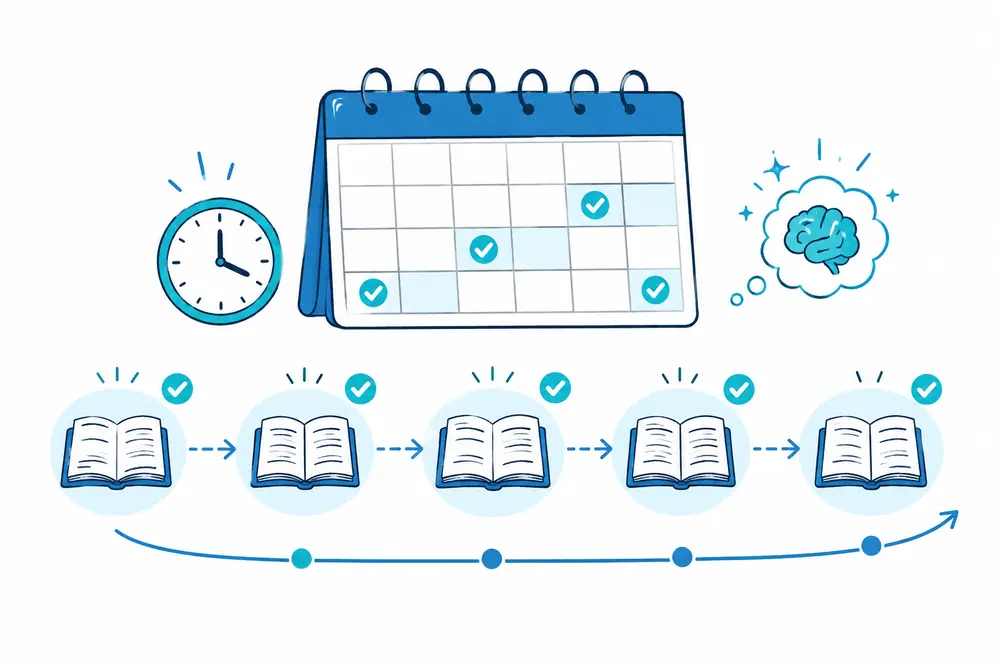
UNC’s strategic test preparation guide recommends linking study methods to course goals. Cornell also explains retrieval and distributed practice.

Digital study guide example
A digital guide can link topics, hide answers, and track review dates. Use headings for the main units. Add collapsible answers when the tool supports them.
Keep one navigation path. Too many links can scatter attention. Store source links beside important claims and update changed material.
Our guide to what a study guide is explains the purpose behind these formats. The study guide contents checklist helps you test the finished version.
How to adapt any example
Replace the sample topic with your own. Keep the learning action. If your goal says compare, create a comparison. If it says solve, add problems.
Check every fact against your course sources. Change the difficulty to match assignments. Add teacher feedback and mistakes from earlier work.
Test the guide without notes. Remove parts that never support recall or practice. For a commercial option, learn what a study guide book contains.
Read next
Compare formats and choose the best study guide for your goal.
Chemistry study guide example
Topic: chemical bonding. Goal: compare ionic, covalent, and metallic bonds. Start with a chart for particles, electron behavior, and common properties.
Add one simple diagram for each bond. Label charges and shared electrons. Keep the drawing tied to the course level.
Practice should mix identification with explanation. Ask why a property follows from the bond. Include one unfamiliar compound for application.
Keep formulas and definitions in a small reference box. Place answers after the question set. Practice makes perfect when feedback stays clear.
Geography study guide example
Topic: river landforms. Goal: explain how erosion and deposition shape a river. Use a labeled diagram from source to mouth.
Add a process table for meanders, oxbow lakes, floodplains, and deltas. Each row should include cause, location, and result.
Practice with a blank diagram and a short case. Ask which process is strongest and what evidence supports the answer.
Maps should include a title, scale, direction, and legend when needed. The small details keep the big picture accurate.
Computer science study guide example
Topic: loops and conditions. Goal: choose the right control structure and trace simple code. Begin with plain-language rules.
Add one worked trace table. Show each variable after every step. Then provide fresh code without the completed table.
Include common errors such as wrong conditions and missing updates. Ask the learner to predict the result before running code.
Finish with a small task that combines a loop and condition. The program is the road test, not the rule list.

Flashcard study guide example
Put one clear prompt on the front. Place a short answer and useful example on the back. Avoid cards that ask several unrelated questions.
Use cards for terms, formulas, dates, symbols, and short concepts. Long essays and multi-step problems need another format.
Say the answer before turning the card. Sort missed cards into a review pile. Return after a gap instead of repeating them immediately.
Remove cards you can answer correctly across several sessions. Keep the deck focused. Less can be more.
Concept map study guide example
Write the main idea in the center. Add branches for categories, causes, parts, or results. Use short labels on every connecting line.
A biology map may connect organelles with functions. A history map may connect events with causes and consequences. The label should explain the link.
Rebuild the map from a blank page. Then compare it with the original. Missing connections show where review should continue.
Do not turn the map into a crowded poster. Split large topics into smaller maps. You cannot see the forest for the trees.
One-page study guide example
A one-page guide works for a small quiz or focused unit. Divide the page into goals, key ideas, examples, questions, and errors.
Use short wording and strong headings. Keep exact formulas and definitions. Remove examples that repeat the same skill.
Leave a section for three weak points. Add the next review date. This keeps the page connected to action.
Do not shrink the text to fit everything. If the page becomes crowded, split the topic. Form should follow function.
Practice test study guide example
List the tested goals before writing questions. Match the question types and difficulty. Use a separate answer section with clear explanations.
Take the practice test without notes. Use a realistic time limit when timing matters. Mark lucky guesses for review.
Sort errors by topic and cause. Study the weak skill before taking another full test. Scores alone cannot show what to fix.
Save a fresh set for the final check. New questions reduce false confidence from memory.
AI-assisted study guide example
Give the AI a verified topic list and learning goal. Ask for questions at recall, explanation, and application levels. Keep answers separate.
Check every fact and answer against course sources. Correct vague wording and remove material outside the required level.
Ask for a fresh example after learning the rule. Solve it before reading feedback. Use AI as a practice partner, not an authority.
Do not share private student data or account details. A safe prompt needs only the learning material and task.

How to check any study guide example
Confirm that the learning goal appears at the top. Every explanation, visual, and question should support that goal.
Hide the answers and test the guide. Add feedback for each common error. Remove sections that never help recall or practice.
Check sources and update dates. Compare the difficulty with real class work. The example should feel familiar, but not too easy.
Set another review date and use the results. A guide proves its value through practice. The proof is in the pudding.
Economics study guide example
Topic: supply and demand. Goal: explain how price and quantity change. Start with clear definitions and labeled curves.
Add a table for shifts in supply, shifts in demand, and movement along a curve. Give one real-life cause for each.
Practice with short cases. Ask which curve changes and why. Then draw the result without looking.
Keep assumptions beside the graph. Small labels prevent large misunderstandings. Mind the small print.
Art study guide example
Topic: elements of art. Goal: identify line, shape, color, value, texture, form, and space in real work.
Create a small example beside each term. Add one artwork reference and explain where the element appears.
Practice with an unfamiliar image. Name the strongest element and support the answer with visible evidence.
Use images you have permission to use. Keep source credits with each example. Creativity and accuracy can share the page.
Group study guide example
Divide topics by learning goal, not page count. Each person creates a short explanation and questions. The group checks every source.
Combine the sections under one layout. Use the same heading names, answer format, and difficulty labels.
Trade questions before the meeting. Everyone should answer alone first. Discussion works better after a real attempt.
Keep personal error lists even when the guide is shared. Many hands make light work, but each mind needs practice.
Blank study guide example
Write the topic, source, and learning goal at the top. Add boxes for key ideas, examples, questions, answers, and errors.
Include a small readiness label and next review date. Leave enough space to write without crowding the page.
Duplicate the blank template for each unit. Change the format when the subject needs a timeline, diagram, or problem set.
Test the template after one topic. Remove empty sections and add missing practice. Let the task shape the tool.

Music study guide example
Topic: basic rhythm. Goal: identify note values and count simple measures. Start with a small symbol and value chart.
Add written measures with the counting marked below. Then provide new measures without the count. Tap or speak the rhythm before checking.
Include one listening task when the course requires it. Use approved audio and record the source. The ear needs practice too.
Mix symbols after the basic patterns feel steady. Variety helps the skill move beyond one familiar example.
Review plan for any example
Use the example once to learn the structure. Rebuild it with your own topic and verified sources.
Test recall the next day. Mark missed ideas and create new questions. Review again after a longer gap.
Finish with mixed practice from several sections. Keep answers hidden until every attempt ends.
Change the example when evidence shows a weakness. If it ain’t broke, don’t fix it, but do test it.
Combine examples without creating clutter
Use one main format for each learning goal. Add a second format only when it tests another useful action.
A timeline can show order, while questions test explanation. A diagram can show parts, while a blank copy tests recall.
Keep answers in one clear section. Repeated keys and notes can make checking harder. Use consistent labels across every format.
Remove a format that never changes your practice. The guide should work like a toolbox, not a storage room.
After combining sections, run one mixed review. Check whether the order feels clear and weak topics remain easy to find.
Save a blank copy before adding content. A reusable structure makes the next unit faster without forcing the wrong format.
Study guide examples FAQ
Can I copy a study guide example?
You can copy the structure. Replace the content with verified course material. Change the questions to match your required skills.
Which example works for every subject?
The basic goal, explanation, example, question, answer, and review structure works widely. The exact visual and practice format should change.
Should a study guide use color?
Color can mark categories and links. Use a small, consistent system. Do not let decoration hide the learning task.
The final takeaway
Good study guide examples share one rule. Their structure follows the learning goal. They explain, test, correct, and schedule review.
Choose one example and build a single topic today. Then close the guide and test it. What could show quality more clearly than that?